OWASP Top 10 Explained: Common Web Application Vulnerabilities in 2026
Introduction
Every day, thousands of websites and web applications are targeted by cybercriminals looking for security weaknesses. Many successful cyber attacks happen because developers and businesses overlook common vulnerabilities during development or fail to perform regular security testing.
The OWASP Top 10 is one of the most trusted security standards used worldwide to identify the most critical risks affecting modern web applications. Whether you own a business website, an e-commerce platform, or a custom web application, understanding these risks can help you protect sensitive customer information and reduce the chances of a cyber attack.
At Sniffer Group, we help organizations strengthen web application security through professional Vulnerability Assessment and Penetration Testing (VAPT), security audits, and cybersecurity consulting. Understanding the OWASP Top 10 is often the first step toward building a secure application.
💡 Quick Tip: Even small security vulnerabilities can become major entry points for attackers if they remain unpatched.
What Is OWASP Top 10?
The OWASP Top 10 is a globally recognized list of the most critical web application security vulnerabilities published by the Open Worldwide Application Security Project (OWASP).
Rather than being a checklist, it serves as a security awareness document that helps developers, business owners, and cybersecurity professionals understand the most common risks affecting web applications.
Organizations across the world use the OWASP Top 10 as a foundation for:
- Building secure web applications
- Performing security assessments
- Conducting penetration testing
- Secure software development
- Employee security awareness training
- Compliance and risk management
Because cyber threats continue to evolve, OWASP regularly updates its recommendations based on real-world attack trends and industry research.
Why Is the OWASP Top 10 Important?
Ignoring application security can lead to serious business consequences, including financial losses, reputational damage, legal issues, and customer trust problems.
The OWASP Top 10 provides a practical framework that helps organizations focus on the vulnerabilities most commonly exploited by attackers.
Key Benefits
- Improves overall website security
- Reduces cyber attack risks
- Protects customer data
- Supports secure software development
- Helps organizations meet compliance requirements
- Strengthens customer trust
- Reduces business downtime
For businesses handling customer information, payment details, or confidential data, following OWASP security recommendations is no longer optional—it is an essential part of cybersecurity.
If your organization wants to evaluate the security of its applications, Sniffer Group offers professional Web Application Penetration Testing (VAPT) services to identify vulnerabilities before attackers do.
OWASP Top 10 Vulnerabilities Every Business Should Know
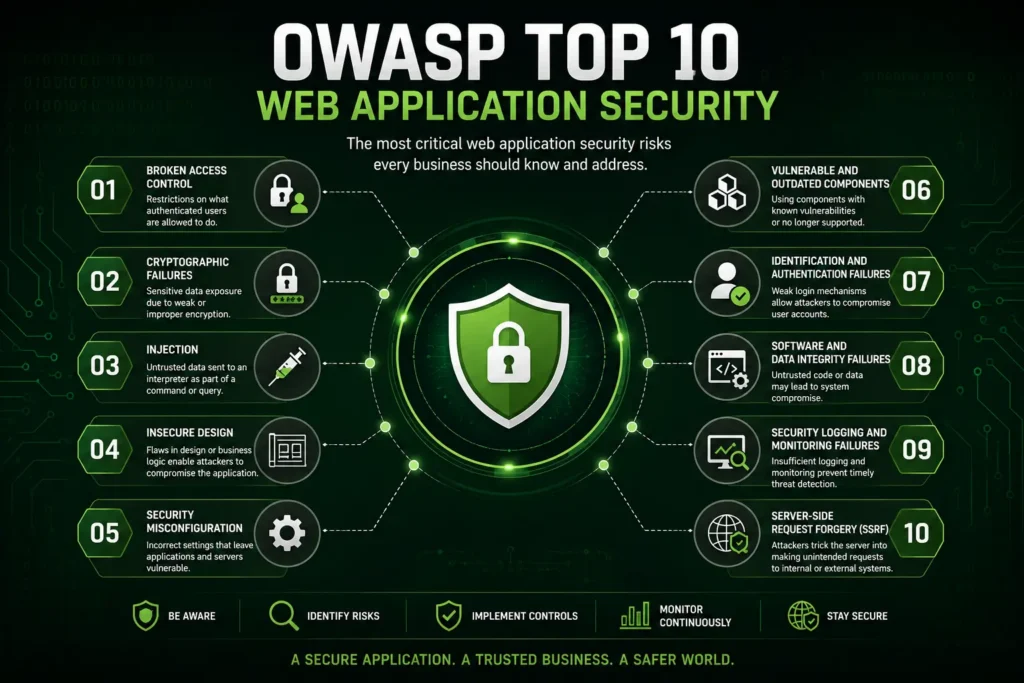
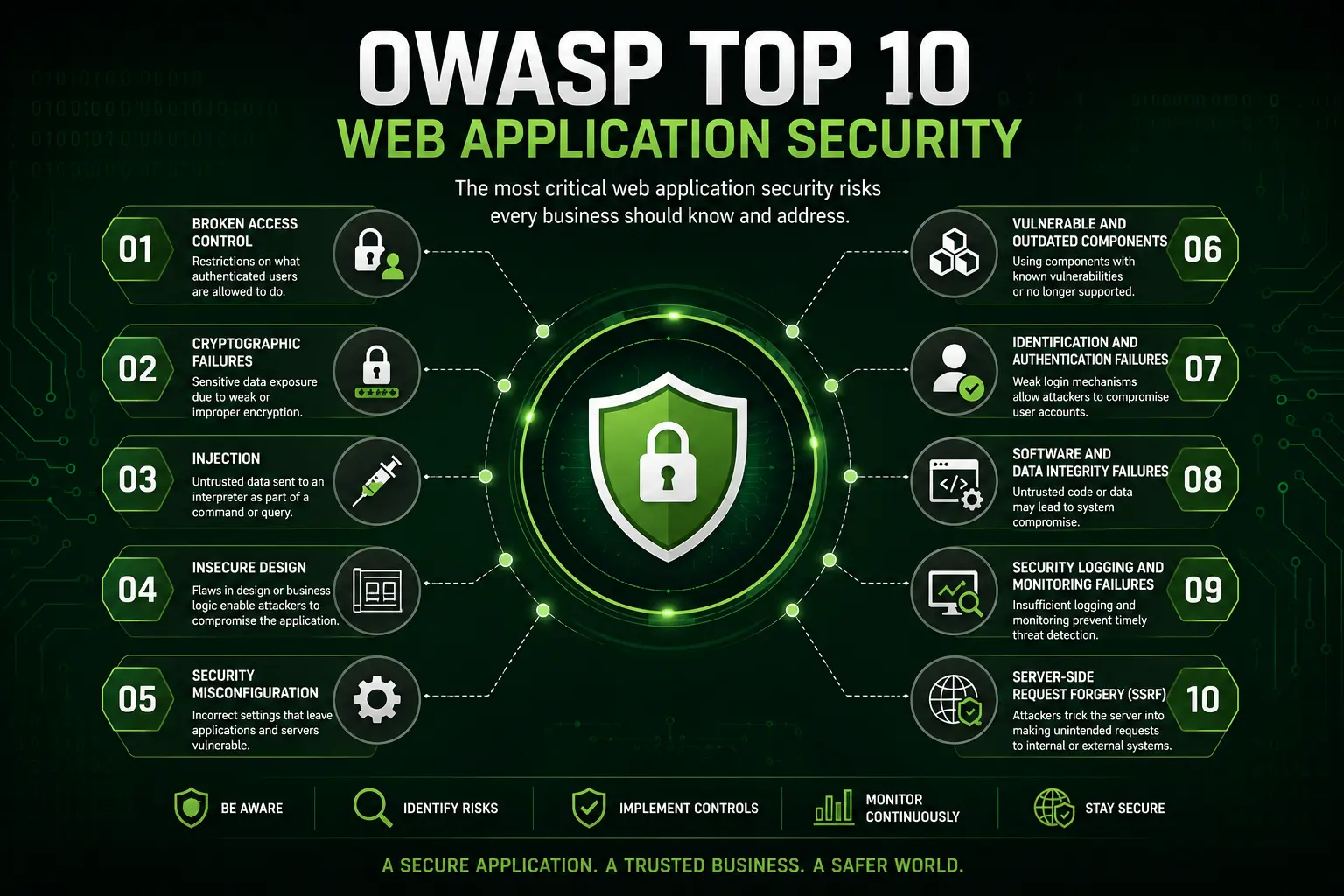
The OWASP Top 10 highlights the most critical security risks affecting modern web applications. Understanding these vulnerabilities helps businesses reduce cyber risks, improve web application security, and protect sensitive customer data.
Let’s explore each vulnerability in simple terms.
1. Broken Access Control
Broken Access Control occurs when users can access data or features that they should not be allowed to use.
For example, an attacker may gain access to another customer’s account or an administrator panel simply by changing a URL or modifying a request.
Common Examples
- Accessing another user’s profile
- Viewing confidential business information
- Unauthorized admin access
- Privilege escalation attacks
Prevention
- Implement Role-Based Access Control (RBAC)
- Validate permissions on every request
- Follow the Principle of Least Privilege
- Perform regular security assessments
2. Cryptographic Failures
Sensitive information such as passwords, payment details, and customer records should always be encrypted.
Poor encryption or storing data in plain text can expose confidential information during a cyber attack.
Common Examples
- Weak password hashing
- Missing HTTPS
- Plain text passwords
- Insecure encryption algorithms
Best Practices
- Use HTTPS everywhere
- Encrypt sensitive data
- Use strong hashing algorithms
- Rotate encryption keys regularly
3. Injection
Injection attacks happen when attackers insert malicious code into an application’s input fields.
One of the most common examples is SQL Injection, where attackers manipulate database queries to access, modify, or delete sensitive information.
Common Injection Attacks
- SQL Injection
- Command Injection
- LDAP Injection
- NoSQL Injection
Prevention
- Validate all user inputs
- Use parameterized queries
- Avoid dynamic SQL statements
- Implement secure coding practices
4. Insecure Design
Even if developers write secure code, poor application design can still introduce serious security risks.
Security should be considered during the planning and development stages rather than after deployment.
Examples
- Missing authentication controls
- Poor business logic
- Weak password policies
- Lack of security architecture
5. Security Misconfiguration
Incorrect server or application settings can leave a website exposed to attackers.
Common Examples
- Default passwords
- Debug mode enabled
- Open cloud storage
- Unnecessary services running
- Incorrect file permissions
Prevention Checklist
- Remove default accounts
- Disable unnecessary services
- Keep configurations updated
- Review server permissions regularly
Need help securing your application?
Sniffer Group provides professional Web Application Security Assessments, security configuration reviews, and VAPT services to identify misconfigurations before attackers exploit them.
6. Vulnerable and Outdated Components
Using outdated plugins, frameworks, or software increases the risk of cyber attacks because attackers often target known vulnerabilities.
Examples
- Outdated WordPress plugins
- Old PHP versions
- Unsupported CMS versions
- Unpatched third-party libraries
Recommendations
- Update software regularly
- Remove unused plugins
- Monitor vendor security advisories
- Apply security patches promptly
7. Identification and Authentication Failures
Weak authentication mechanisms allow attackers to compromise user accounts.
Common Issues
- Weak passwords
- Password reuse
- Missing Multi-Factor Authentication (MFA)
- Poor session management
Security Tips
- Enforce strong password policies
- Enable MFA
- Limit failed login attempts
- Monitor suspicious login activity
8. Software and Data Integrity Failures
Applications should only trust verified software, updates, and third-party libraries.
If attackers modify application code or software updates, they can distribute malware or gain unauthorized access.
Prevention
- Verify software integrity
- Use trusted repositories
- Protect CI/CD pipelines
- Digitally sign software updates
9. Security Logging and Monitoring Failures
Without proper logging and monitoring, organizations may not detect cyber attacks until significant damage has already occurred.
Best Practices
- Monitor login attempts
- Log critical system events
- Detect suspicious activities
- Enable real-time alerts
- Review security logs regularly
10. Server-Side Request Forgery (SSRF)
SSRF allows attackers to trick a server into sending requests to internal or external systems that should not be accessible.
This can expose sensitive cloud resources, internal services, and confidential business data.
Prevention
- Validate outgoing requests
- Restrict internal network access
- Use allowlists for trusted URLs
- Disable unnecessary network access
Quick Overview of the OWASP Top 10
| Vulnerability | Business Impact |
|---|---|
| Broken Access Control | Unauthorized access to sensitive data |
| Cryptographic Failures | Data exposure and compliance risks |
| Injection | Database compromise and data theft |
| Insecure Design | Security weaknesses in application architecture |
| Security Misconfiguration | Increased attack surface |
| Vulnerable Components | Exploitation of known vulnerabilities |
| Authentication Failures | Account takeover attacks |
| Data Integrity Failures | Malware and software compromise |
| Logging Failures | Delayed attack detection |
| SSRF | Internal network exposure |
💡 Security Tip
Regularly reviewing your applications against the OWASP Top 10 helps identify security gaps before attackers exploit them. If your organization needs expert assistance, Sniffer Group provides professional Vulnerability Assessment and Penetration Testing (VAPT) services, security audits, and remediation guidance to help strengthen your web application security.
How to Protect Your Web Applications from the OWASP Top 10 Vulnerabilities
Understanding the OWASP Top 10 is only the first step. Businesses should also implement practical security measures to reduce cyber risks and protect their web applications from evolving attacks.
Below are some of the most effective security practices.
Follow Secure Coding Practices
Developers should write secure code from the beginning of the software development lifecycle. Secure coding reduces vulnerabilities before applications are deployed.
Best Practices
- Validate all user input
- Use parameterized database queries
- Sanitize uploaded files
- Avoid hardcoded credentials
- Follow secure development guidelines
Perform Regular Vulnerability Assessments
Regular security assessments help identify weaknesses before attackers discover them.
Organizations should test their applications whenever:
- A new feature is released
- Major updates are deployed
- Third-party components are added
- Security incidents occur
Regular testing significantly improves web application security and reduces business risks.
Conduct Professional Penetration Testing
Automated scanners cannot identify every security issue.
Professional penetration testing combines automated tools with manual testing techniques to discover real-world vulnerabilities that attackers may exploit.
At Sniffer Group, our cybersecurity experts perform comprehensive Web Application Penetration Testing (VAPT) to identify security gaps, validate vulnerabilities, and provide practical remediation recommendations.
Keep Software and Components Updated
Many cyber attacks target outdated software with publicly known vulnerabilities.
Always keep your:
- CMS
- Frameworks
- Plugins
- Libraries
- Operating Systems
- Web Servers
updated with the latest security patches.
Implement Strong Authentication
User authentication plays a major role in application security.
Consider implementing:
- Multi-Factor Authentication (MFA)
- Strong password policies
- Account lockout protection
- Secure session management
- Password hashing
Monitor and Respond to Security Threats
Cybersecurity is not a one-time activity.
Businesses should continuously monitor their applications for suspicious activity.
This includes:
- Log monitoring
- Security alerts
- Intrusion detection
- Threat intelligence
- Incident response planning
Why Choose Sniffer Group for Web Application Security?
Cyber threats continue to evolve, making professional security testing more important than ever.
Sniffer Group helps businesses improve their security posture through comprehensive cybersecurity services.
Our Services
- Web Application Penetration Testing (VAPT)
- Vulnerability Assessment
- Website Security Audits
- API Security Testing
- Security Consultation
- Malware Analysis
- Cyber Security Awareness Training
Our experienced security professionals identify vulnerabilities, explain business risks, and recommend practical solutions that help organizations build secure web applications.
Conclusion
The OWASP Top 10 serves as an essential security framework for developers, businesses, and cybersecurity professionals. Understanding these vulnerabilities helps organizations build stronger applications, protect sensitive customer information, and reduce the risk of cyber attacks.
However, knowing the risks is only part of the solution. Regular security testing, secure coding practices, timely updates, and continuous monitoring are equally important for maintaining a secure environment.
If you want to evaluate your application’s security or need expert guidance, Sniffer Group offers professional Web Application Penetration Testing (VAPT), Vulnerability Assessments, and cybersecurity consulting services to help protect your business from modern cyber threats.
Frequently Asked Questions (FAQ)
1. What is the OWASP Top 10?
The OWASP Top 10 is a globally recognized list of the most critical web application security risks published by the Open Worldwide Application Security Project (OWASP).
2. Why is the OWASP Top 10 important?
It helps developers and businesses understand the most common vulnerabilities and improve overall web application security.
3. Who should follow the OWASP Top 10?
Developers, business owners, security teams, IT professionals, and organizations that develop or manage web applications should follow these security guidelines.
4. How often is the OWASP Top 10 updated?
OWASP updates the list periodically based on industry research, emerging threats, and real-world attack trends.
5. Does the OWASP Top 10 guarantee complete security?
No. It provides a strong security foundation, but organizations should also perform regular security assessments, penetration testing, and continuous monitoring.
6. How can Sniffer Group help improve web application security?
Sniffer Group provides professional Web Application Penetration Testing (VAPT), Vulnerability Assessments, Website Security Audits, API Security Testing, and cybersecurity consulting to help businesses identify and fix security vulnerabilities.